

 Rebecca PY
MALAYSIA, 28 OCTOBER – Young Malaysian students demonstrated exceptional technological ingenuity at the AI Muda at NADI Hackathon 2026, creating artificial intelligence driven solutions tailored to solve pressing challenges in Malaysia plantations and commodities sector.
Centred on the theme AI Innovation for the Future of Plantations and Commodities, the competition brought together 26 finalist teams representing secondary schools from Form 1 to Form 6 nationwide. The young participants engineered AI tools targeting plantation productivity, environmental conservation, smart farming practices, and sustainable commodity development.
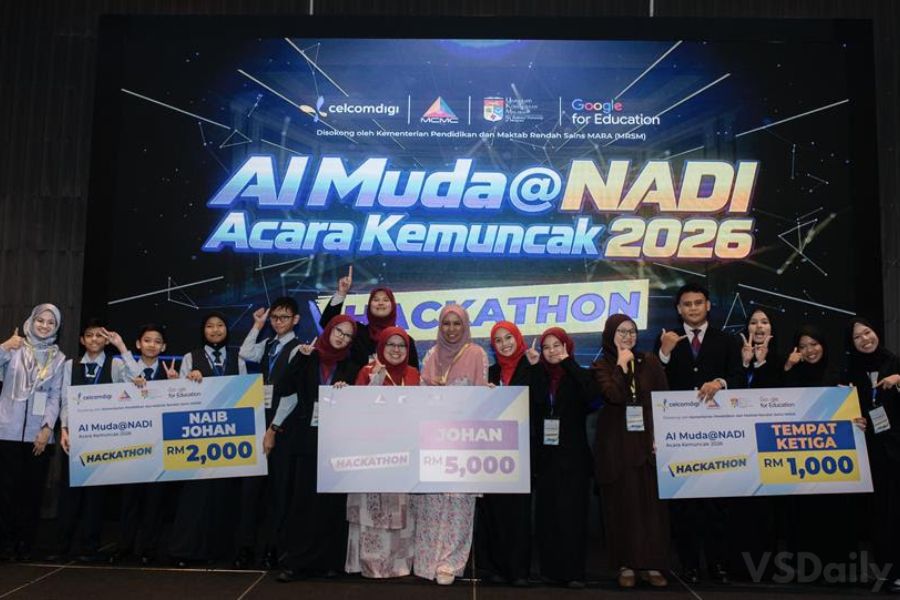
Securing the championship title after two days of intense competition, team INNOVIQ from Kolej Vokasional Perdagangan Johor Bahru earned top honours for developing TerraScan. The smart agriculture application combines intelligent soil testing, crop recommendations, weather forecasting, farm simulation, and operational financial management to empower local growers. Designed to elevate crop yields, trim operational overheads, strengthen food security, and champion sustainable agriculture, the champion walked away with RM5,000. The first runner-up received RM2,000, while the second runner-up took home RM1,000.
The national competition served as the grand finale of AI Muda at NADI, an initiative organized under the AI at NADI Training Programme 2026. Launched by the Malaysian Communications and Multimedia Commission in collaboration with CelcomDigi through the National Information Dissemination Centres, the programme drew participation from over 9,000 secondary school students. Participants completed six comprehensive modules covering prompt engineering, responsible AI usage, digital content generation, and productivity workflows before undergoing assessment through an online evaluation platform.
Finalists were judged across four key elements, namely AI applications created via vibe coding, AI video production, prompt engineering trails, and project documentation cards. Submissions were evaluated on problem relevance to Malaysian challenges, solution viability, and alignment with the United Nations Sustainable Development Goals. Each qualifying team consisted of four students guided by a supervising teacher, ensuring full representation across every Malaysian state.
The programme was delivered in partnership with Universiti Kebangsaan Malaysia Faculty of Education and Google for Education, alongside endorsement from the Ministry of Education and Maktab Rendah Sains MARA.
CelcomDigi Chief Enterprise Business Officer and Acting Chief Innovation Officer T. Kugan highlighted that the initiative unites public sector governance, academic institutions, technological infrastructure, and local communities. He noted that connecting these ecosystems enables young Malaysians to turn ambitious AI concepts into functional skills, equipping future talent to navigate and build the nation digital economy.
Following the success of the secondary school programme, MCMC and CelcomDigi plan to roll out the AI at NADI Training Programme to university students and working professionals nationwide, expanding opportunities for technical upskilling and long-term career readiness.